Helicopter
Description:
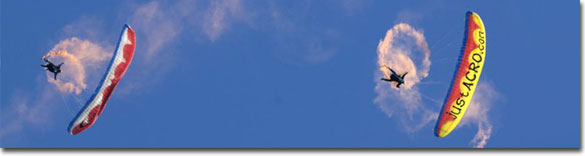
The Helicopter is actually a controlled Spin, whilst the glider is totally open, the pilot is straight under the wing, and the rotation is stable (the wing turns like the rotor of a helicopter). The sinking rate is quite low, around 2-3 m/s.
This is one of the most difficult manouvres, which requires very precise brake handling from the pilot. If you really want to learn this trick, you have to go for it, and forget to practice everything else!
Preparation:
To prevent riser twisting, set your harness to sitting position, release the chest strap as much as possible, put your legs under your harness and be ready to turn with your glider.
Enter:
This manouvre is extremely sensible for turbulences, especially during the entering. Try to practice only in completely calm air.
In the following text I describe a Helicopter to the right:
Slow down the glider to minimum speed by gently and symmetrically braking. Once it stabilized over you (doesn’t swinging anymore), apply just a little bit more brake to get the glider into deep stall (the brake pressure gone and the glider loose it’s horizontal speed). When the canopy is completely above you and the descending is stable, release the left brake, grab the left riser, and just keep the right brake (or pull only few centimeters more) at the same moment. Just after the the glider starts the rotation, gently release the right brake almost completely, until the point where you feel the brake pressure starts to increase and the Helico became stable. Usually you have to pull only 5-10 centimeters to keep the glider in Helicopter. If you pull too much brake, the wingtip will collapse.
If during the entering the glider starts to turn a little bit in front, the deep stall was not strong enough (you didn’t brake enough). In this case, you may also have to pull a little bit more on the negative side to start the rotation (and it’s not ideal). Shift your weight to the negative side until you swing back under the glider, than return to the center.
Also take care not to pull to much brake in the deep stall, otherwise the glider gets a little bit behind you (as it starts to slide backwards) and that’s also not a good position to start.
In the Helicopter you can play also a lot with your body. Not only the handling of the brakes, but the right weight-shifting is also important. Above all, at the beginning of your practice the best what you can do is to stay in the center. You also have to learn how to control your body if the rotation is unstable, because you can easily generates big oscillation just by wabbling in your harness from one side to the other and moving your hands (and the brakes!) up and down anawares, cause even few centimeters can makes huge difference!
In a stable Helico, you can increase the speed of the rotation by gently shift your weight to the positive side.
There are only few pilots in the world who are able to correct an ugly Helicopter and switch it to a perfect one. It’s not really an exact knowledge, more like a sense, what everyone has to discover by itself. Especially because the right technique can be different, depends on the glider. But it will come gradually and spontaneously for sure, by hard traning, after hundreds and thousands of Helicopters.
But basically, if the rotation is unstable try the following technique:
Gently pull a little bit on the outside brake to slow down the rotation. When the glider is turning slowly, it calms down and it’s easier to stabilize. Than when the glider is straigt above you, try to find the right moment and accelerate it again by releasing the outside brake slowly. Of course in the meanwhile, right weight-shifting can also help a lot.
Exit:
If the rotation is stable, it’s very simple to exit. Just center your body, release the brake and control the following surge, which is usually a bit asymmetrical.
You can also exit by pulling down the outside brake (but don’t stall it!) and release the negative a little bit, until the glider stops. Than let it shoots forward and brake the surge.
At the beginning the safest way could be to pull down both brakes and Full Stall the glider. Gradually you will get the feeling how to exit safe even from the ugliest Helicos (or Spins) without stalling the glider.
All dangers of Spin Be very confident with Spins and Full Stalls before you try this manouvre. Because the glider has no horizontal speed in Helicopter, the stall point is located higher on the brakes, so you have to make only very gently and short brake inputs not to overreact.